
Ay (pharaoh)
Penultimate pharaoh of Egypt's 18th Dynasty, former vizier to Tutankhamun.

Ay was the penultimate pharaoh of ancient Egypt's 18th Dynasty, ruling for a brief four-year period in the late 14th century BC. Prior to his reign, he served as a close advisor to two, and possibly three, other pharaohs of the dynasty, and is speculated to have been the power behind the throne during the reign of the child ruler Tutankhamun. His prenomen Kheperkheperure means 'Everlasting are the Manifestations of Ra', while his nomen Ay it-netjer reads as 'Ay, Father of the God'.
- Dynasty
- 18th Dynasty
- Reign length
- Four years (possibly up to seven to nine years)
- Prenomen
- Kheperkheperure
- Nomen
- Ay it-netjer
- Great Royal Wife
- Tey
- Successor
- Horemheb
- Notable for
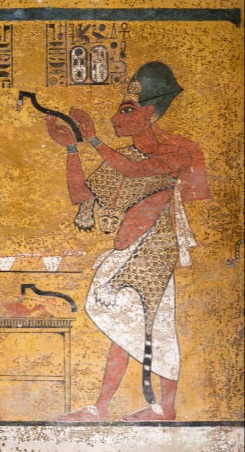
- Serving as vizier to Akhenaten and Tutankhamun; depicted performing the Opening of the Mouth ceremony at Tutankhamun's burial
Lore & Background
Ay is believed to have been from Akhmim, where he built a rock-cut chapel dedicated to the local deity Min during his short reign. He may have been the son of the courtier Yuya and his wife Thuya, making him a brother of Tiye and Anen, though this theory rests entirely on circumstantial evidence. His Great Royal Wife was Tey, known as the wet-nurse to Nefertiti, and it is often theorized that Ay was the father of Nefertiti, but nowhere are Ay and Tey referred to as her parents. Nakhtmin, Ay's chosen successor, was likely his son or grandson, with his mother Iuy possibly being Ay's first wife.
Reader's Guide
Ay's significance lies in his transition from a high-ranking advisor and vizier under Akhenaten and Tutankhamun to pharaoh himself, filling the power vacuum left by Tutankhamun's death. He is depicted conducting the funerary rites for the young king, a unique explicit depiction of a succeeding king performing the Opening of the Mouth ceremony. His reign was short, and records and monuments clearly attributable to him are rare, partly due to his successor Horemheb's campaign of damnatio memoriae against him and other pharaohs associated with the Amarna Period. Ay consolidated the return to traditional religious practices and constructed a mortuary temple at Medinet Habu. The precise length of his reign is unknown, with a Year 4 stela of his chosen successor Nakhtmin providing a minimum, but Manetho's Epitome assigning four years and one month to Horemheb has been reinterpreted. Ay's legacy is thus intertwined with the turbulent end of the 18th Dynasty and the erasure of Amarna-era rulers.
Did You Know?
- Ay's prenomen Kheperkheperure means 'Everlasting are the Manifestations of Ra'.
- He is depicted on a wall of Tutankhamun's burial chamber performing the Opening of the Mouth ceremony, a unique explicit depiction.
- Egyptologist Bob Brier suggested Ay murdered Tutankhamun to usurp the throne, but CT scans in 2005 found no evidence of a blow to the head.
- Ay's mummy has not been located, though fragmentary skeletal remains from his tomb may represent it.
Gallery
Frequently Asked Questions
Who is Ay (pharaoh)?
Ay was the second-to-last king of Egypt's 18th Dynasty, taking the throne in the late 14th century BC after the death of Tutankhamun. He reigned for approximately four years before being succeeded by Horemheb.
What was Ay's role before he became pharaoh?
Before ascending the throne, Ay held the position of vizier and close advisor to multiple 18th-Dynasty rulers, most notably the child-king Tutankhamun. Many Egyptologists suspect he was the de facto ruler guiding policy during Tutankhamun's minority.
What were Ay's royal names and what do they mean?
His prenomen, Kheperkheperure, conveys the idea that the manifestations of Ra are everlasting, while his nomen, Ay it-netjer, translates as 'Ay, Father of the God.'
Who was Ay's Great Royal Wife and who came after him?
His Great Royal Wife was Tey, and the throne passed to Horemheb, a former military commander. Ay's direct royal line effectively ended with his reign, making him the penultimate pharaoh of the dynasty.
Why is Ay important in 18th Dynasty history?
Ay's brief rule marks the final chapter of the 18th Dynasty and sits at the crossroads of the post-Amarna restoration period, linking the upheaval of Akhenaten's religious revolution to the dynasty's eventual close under Horemheb.
More in Ancient Rulers Of Africa And The Near East 1-24
Elsewhere in the Ancient Rulers Of Africa And The Near East universe
Spotted an error? Know more?
This is a living reference — every entry is fact-audited, and reader corrections feed straight into our audit queue. Suggest an edit · See this site's audit record